
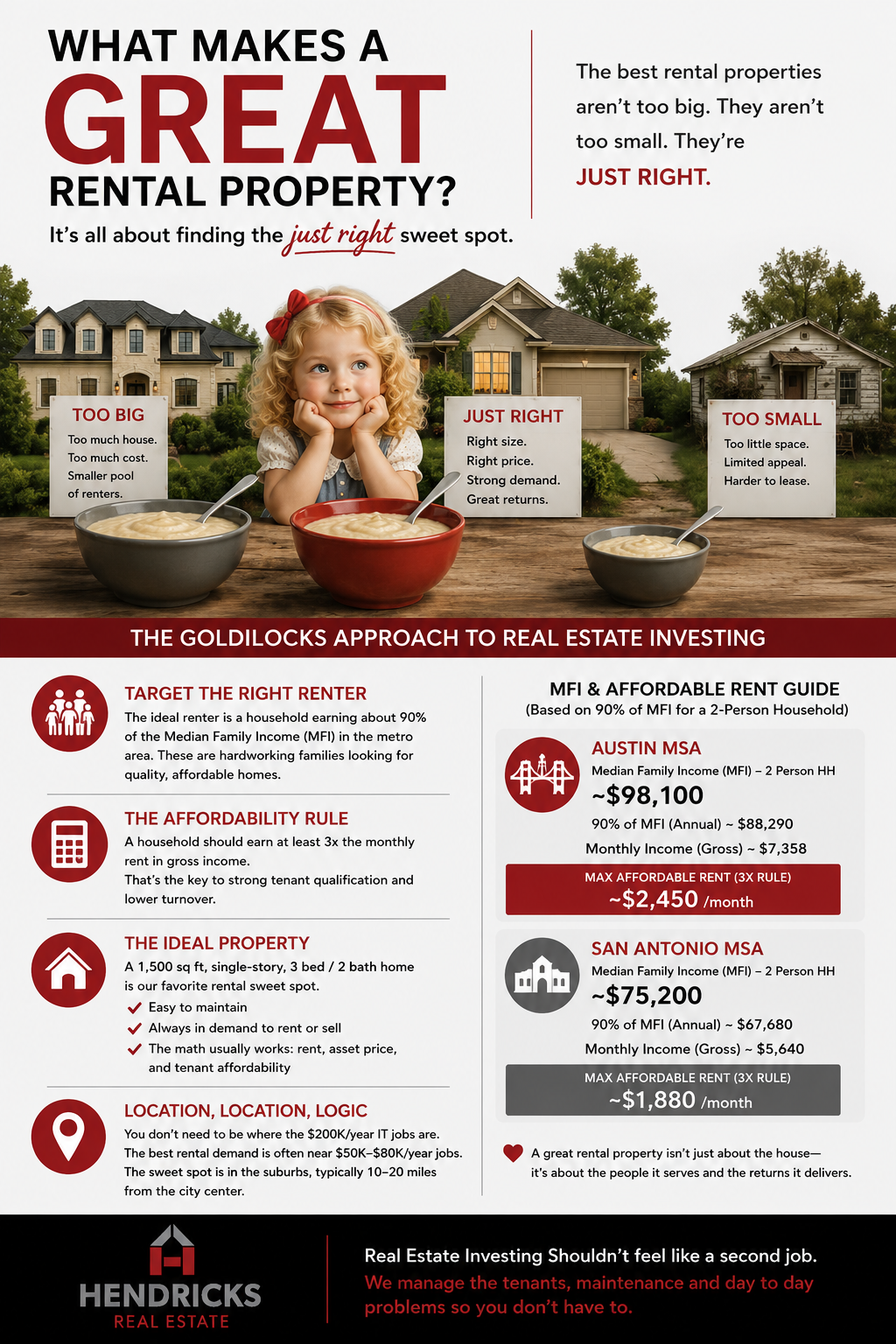
What makes a great rental property?
After more than 25 years as a real estate investor, I've come to believe the answer is surprisingly similar to the lesson from a children's story.
The best rental properties are a lot like Goldilocks' porridge.
They're not too big.
They're not too small.
They're just right.
Unfortunately, many investors spend years chasing properties that fall into one of the two extremes.
Some buy homes that are too large and too expensive for the local renter pool. Others buy properties that are too small, too outdated, or located in areas with limited tenant demand.
The most successful rental properties typically sit right in the middle.
The "Just Right" Rental Property
My favorite rental property is often a simple, single-story 3-bedroom, 2-bath home of approximately 1,500 square feet.
That may not sound exciting, but there are several reasons these homes consistently perform well. They are:
Affordable to a broad segment of renters
Easy to maintain
Attractive to families
In demand whether you're renting or selling
Often well-positioned from a rent-to-value perspective
Most importantly, they appeal to the largest possible pool of qualified tenants.
Follow the Tenant, Not the Headlines
A common mistake investors make is focusing on where the highest-paid workers live.
It's easy to assume the best rental properties should be located near employers paying $200,000 per year.
In reality, many of the strongest rental markets are supported by households earning $50,000 to $80,000 annually.
Teachers.
Healthcare workers.
Tradespeople.
Government employees.
First responders.
Logistics and manufacturing workers.
These households represent a significant portion of the rental market, and they need quality housing that fits their budgets.
Understanding Affordability
One of the principles we use when evaluating rental housing is affordability.
Generally, tenants should earn at least three times the monthly rent in gross income.
Many of the strongest rental prospects in Austin and San Antonio earn approximately 90% of the area's median family income.
When a rental property is priced within reach of these households, owners benefit from a much larger pool of qualified applicants, which often translates into lower vacancy and better long-term performance.
Location, Location... Logic
The ideal rental property isn't necessarily downtown.
In many cases, the sweet spot lies in suburban communities located 10 to 20 miles outside major employment centers.
These areas often offer:
Strong schools
Family-friendly neighborhoods
Better affordability
Stable tenant demand
More attractive investment economics
This is one reason many Central Texas investors have found success in communities surrounding Austin and San Antonio.
Why Bigger Isn't Better
Larger homes generally come with:
Higher purchase prices
More maintenance
Larger turnover expenses
Smaller pools of qualified tenants
A properly designed 1,500-square-foot home frequently attracts just as much demand as a much larger property while offering better overall investment performance.
The goal isn't to own the biggest house.
The goal is to own the house that attracts the best tenants year after year.
The Goldilocks Test
When evaluating a potential rental property, ask yourself:
Is it affordable to a broad segment of working families?
Is the floorplan functional?
Is it located near stable employment?
Is it easy to maintain?
Would I have a large pool of qualified tenants if it became vacant tomorrow?
If the answer is yes, you may have found a property that's not too big, not too small, but just right. And in rental property investing, "just right" is often where the best long-term returns are found.